Northern Canals Association’s Autumn Meeting 2025
with the Shrewsbury & Newport Canal Trust
Saturday, 5 October 2025
With the last gasps of Storm Amy ruffling the waters of Norbury Junction and causing the curtains in the windows to balloon, the 42 delegates gathered at the Junction Inn, Norbury, Shropshire, for the autumn meeting of the Northern Canals Association (NCA) on Sunday 5 October 2025.
Having braved Norbury’s narrow lanes to access this once busy but remote junction of the Shrewsbury and Newport Canal with the Shropshire Union system, and with its atmospheric remains of maintenance yard, stabling and dry dock, the day began with the usual welcome and ‘housekeeping’ from Ivan Cane, chair of the NCA.
The hosts for the day were the Shrewsbury & Newport Canals Trust (S&NCT), formed in 2000 to return the Shrewsbury and Newport Canals to navigation. Bernie Jones, chair S&NCT, echoed the welcomes and gave an overview of the canals and the trust, past present and future. Opened in 1797 the Shrewsbury Canal gave that town access to south Shropshire’s coal supplies, joining the Shropshire Tub Boat system at Trench, now part of Telford. In 1835 the line to Newport was opened, joining the then Birmingham & Liverpool Junction Canal, now Shropshire Union canal, at Norbury, to the existing Shrewsbury canal at Wappenshall, its significance marked by the construction of the huge covered warehouses and basin that still dominate the site today. Abandoned in 1944 much of the line of the canals was sold off in the 1960s but little was subsequently built on and no insuperable engineering problems lie in the way of restoration. The Trust’s energies are currently concentrated on restoring Wappenshall Warehouse – completion due autumn 2025 when it will be opened as a visitor centre and cafe, – Rodington, where the walls and some parts of an original timber lift bridge have been unearthed and Berwick Tunnel portals where the re-establishment of the towpath is taking place. In addition, the Trust owns two 1930’s Woolwich Class heritage boats, Bainton and Berkhampstead, which are undergoing restoration at Norbury and which are intended for transfer to Wappenshall Basin in spring 2026. Future plans also include the rebuilding of Fishers Lock, Newport, building a replica lift bridge at Rodington and re-watering Berwick Tunnel where proximity to the National Trust’s Attingham Park could well increase local tourism.
The ‘professionals’ then took over for a while with Charles Hughes, Environmental Officer, CRT West Midlands, delivering a fascinating presentation on ’Non-native invasive species and their control’ on CRT waterways. Few of us, I imagine, are unaware of the spread and threat to native species of plants such as Himalayan balsam, giant hogweed and Japanese knotweed, currently costing the UK economy some £4 billion pa. It was heartening then to learn that, by a mixture of mechanical, chemical and biological control, CRT are tackling the problems with a reported 61% reduction in the total treatment area of giant hogweed and an average of 79% reduction in the treatment areas of Japanese knotweed, especially across Green Flag canals. Of especial interest was the development and implementation of the ‘first of its kind’ treatment for Himalayan balsam, a treatment pioneered on the Penarth feeder of the Montgomery Canal, itself a Special Area of Conservation (SAC) and Site of Special Scientific Interest (SSSI) and heavily under threat from encroaching balsam. By installing a biodegradable hessian/jute matting on top of the itinerant plant alongside the feeder, dredging the feeder and depositing the dredgings on top of the matting, then hydroseeding native grasses and wild flowers on the top impressive results have been obtained. Continued monitoring is, of course, imperative.
Equally if not more impressive is the progress being made in biological control of floating pennywort – that bane of many a boater’s life, especially on less frequented routes, and which grows so fast it is able to triple its mass in weeks. Thus far this native of North America has largely been ‘controlled’ by mechanical means, 1.467 tonnes being removed from 35k of the River Soar alone during 2022/3. Long term research into biological control has identified the South American weevil as, possibly, the ‘golden nugget.’ Now cleared for use in the UK this insignificant looking but powerful creature eats the leaves of the pennywort and lays its eggs in the stems. The larvae then tunnel into the stems causing the plant’s dense mats to collapse. Results so far are encouraging, especially in the south and midlands. The weevils are clearly not so keen on the colder winters of the north though.
Finally, Charles reported on the Trust’s progress in identifying and combatting nutrient enrichment in our canals and water courses. Using all available research tools, both desk bound and on site, it is obvious that nutrient enrichment is at its most excessive at outfalls or at the site of sewage discharge incidents. Phosphorous is the most culpable nutrient, being retained in silt, and potentially contributes to the persistence of outbreaks of some invasive plants, with external sources thought to be a significant contributor. It is believed that low cost, small land management changes could result in large reductions in nutrient run-off/leaching. Another case for wider education, no doubt? As noted before, a totally fascinating presentation with a richly deserved round of applause and congratulation.
With a hard act to follow Henriette Bruekelaar, Regional Director, West Midlands, then took to the floor with an update on CRT’s Restoration Development Plan (RDP) – a somewhat ‘contentious’ recent product in canal restoration circles. Confirming, to the almost audible sound of relief around the room, that the Trust is committed to keeping the waterways open and alive, Hen went on to outline how difficult decisions are inevitable as the Trust faces its current funding crisis.
The case for making changes in the ‘restoration process’ was then outlined. Having received feedback from 56 restoration groups since the first publication of the RDP in the spring multiple concerns were outlined: cost, the complicated process involved, the qualifications needed simply to work on a restoration, the negative tone of the document, volunteers being asked to pay for activities that, ultimately, improve the Trust’s assets and the Trust hindering restoration when they should be supporting it, especially in view of its stated charitable objectives.
Thus CRT have gone away and had a think – and now propose that on the question of cost initial conversations on a proposed restoration will not be charged for and, to remove any costs related to CDM Client duties, the section of canal proposed for restoration could be leased. The legal beagles are now at work but if leasing is a solution the Trust will still need to ensure the quality of the work.
On the other thorny subject of qualifications for restoration volunteers the revised thinking is that with full supervision, those working on the ‘construction site,’ which is what in essence any restoration site is, just need to have ‘appropriate instruction per task’ as opposed to having completed a CITB Health & Safety Awareness Course (2 days in length and at commensurate cost). Meantime, the IWA is considering/taking advice on whether their honorary engineers can fulfil the role of designer under their IWA professional indemnity insurance.
Whilst there is no option to remove the ‘steps’ involved in the RDP, as these follow the CDM regulations, CRT have undertaken to clarify that, for simple projects, some steps can be completed quite quickly and they will work on the ‘tone’ of the document to ensure it portrays support. CRT has written to all restoration societies, summarising this feedback and advising on updated proposals. They have also offered to meet with individual societies, especially those who work on their land, to discuss this further.
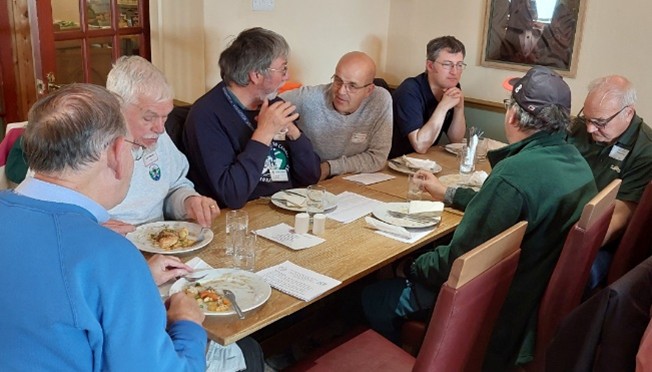
Following two such absorbing presentations and with time pressing on, not to mention the delectable aromas percolating from the kitchens, that stalwart feature of all NCA gatherings, accompanied by Ivan’s incomparable but unpredictable map, the Group Updates, commenced:
- North Walsham & Dilham Canal Trust – David Batley echoed Charles Hughes words on the Pennywort Problem, advising never to cut in September or October but at every other time of year.
- Herefordshire & Gloucestershire Canal – Ralph Barber reported on Elston Tunnel into Hereford, housing and a canalised river in Ledbury and a public consultation, a (railway) platform clearance and an inclined plane in Newent.
- Towpath Talk – Lucy Wood, new editor at TT, being unable to attend in person, sent a very ‘windy’ on-line greeting and introduction from Louth.
- Lichfield & Hatherton Canal Trust – Bob Williams reported on possession (of the canal line), permission, with reference to bridges, and funding, as L&HCT currently have six funding schemes ongoing.
- Montgomery Canal Restoration – David Carter from SUCS, having been given an outline script only the day before and having no idea what pictures were to be presented for illustration, manfully coped with describing recent developments alongside past projects.
- Manchester, Bolton & Bury Canal – Sam Kennion updated on history of the breach and its now hopeful repair, housing developments and events in Salford.
Please email if you would like a copy of all the morning’s slides)
A Sunday Roast lunch and that most invaluable of pastimes, networking, then took place.
For the afternoon the ‘host’ was divided into four groups to visit, in no particular order of distinction:
- The S&N boats, Bainton & Berkhampstead, moored across the way at Norbury Junction.
- The Newport ‘Black Shed’ to see examples of the work carried out on this section.
- Rodington to view the unearthed walls and remains of a lift bridge.
- Berwick Tunnel to view the restored portal and towpath re-establishment.
Bainton & Berkhampstead
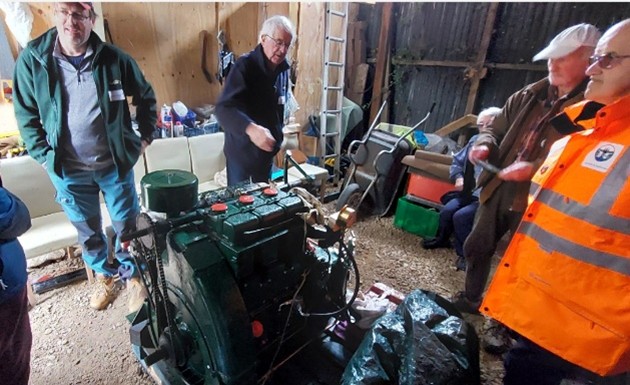
Paul Rawlings was our guide, and he took us across to the boat’s moorings. He described how Roger White had donated the boats to the Trust, and their following adventurous journey from Northamptonshire to Norbury, crewed by volunteers, back in 2020. The large Woolwich Town class boats had been built in 1934, and had been designed to work as a pair from the beginning.
Paul outlined the considerable work that has taken place over the past 5 years – and the Trust’s intended use for them in the future. We were also taken to see the engine, with a video showing the first time it had been fired up since the volunteer’s refurbishment.
Following the visit, we were set free in the Trust’s shop to browse the canal related goods that had been put out to tempt us. And we were tempted. (Ivan Cane)
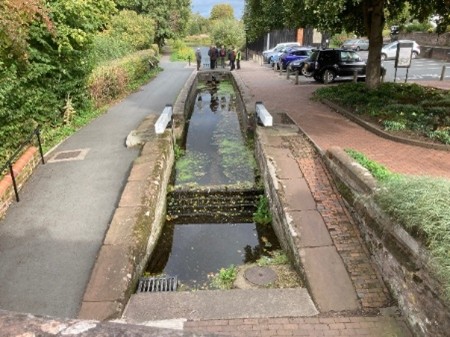
My pre-conceived notion of a derelict Newport Canal was soon dispelled when our guide took us to the “bottom” lock from the long flight down from Norbury Junction. Having fallen into disuse, this structure has been modified, but in a sympathetic way to look like a working lock, albeit reduced in height and closed off by the cross-over footpath.
The surprising thing is that the canal channel lies level into the middle-distance with an abundant water supply and banks being maintained in good condition even without water traffic.
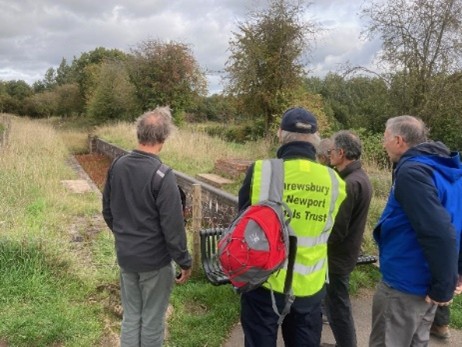
The next lock along has been modified in much the same way but very little work would be needed to recommission it as a working lock. Much the same with the third lock too, where we turned around and returned to the starting point.
Of course, a great deal would need to be done further away to render the whole canal navigable again but it is comforting to know that at least these lock chambers have been preserved in place with only comparatively modest effort and expenditure needed to bring them back to life, if only the boats could get there! (Bob Williams)
Rodington
Under the amiable and extremely knowledgeable guidance of Alistair Price we visited the quiet hamlet of Rodington where the remains of wing walls of a lift bridge have been unearthed together with (through advertisement and encouragement) other items of ironware and engineering pertaining to this. Lift bridge abutments and subsequent embankment are being uncovered, together with fascinating minor but beautifully engineered works. They did not stint in quality in those days! The village are very supportive in the restoration and re-instatement which is very heartening. Time allowed for a visit and walk-over of Longdon on Tern Aqueduct, a Grade 1 listed structure, one of the first two iron aqueducts in the UK; a beautiful end to a very satisfying visit. (Sue Ball)
Berwick Tunnel
This group was ably led by Chas Warren on visits to Berwick and Uffington at each end of this Shrewsbury & Newport Canal tunnel. It’s history was fascinating with donkeys towing on an original wooden towpath, we saw the donkey hovel. Restoration either end of the tunnel is progressing well with work on towpaths and removing large obstructing trees, recycled as logs. An excellent visit. (Ivor Caplan)
With ‘Amy’ by now well and truly out of the way we re-convened at Norbury for final words of wisdom. We agreed it had been another most informative, entertaining and enjoyable day, with grateful thanks to the S&NCRT for whom it was their third hosting of this event. The catering had been quite sublime so many thanks to all the staff at the Junction Inn. We were exhorted to put the date Sunday March 22nd 2026 on the Chesterfield Canal in our diaries when we could all repeat today’s most satisfying experience. And finally, Ivan would really, really like to retire, [HE WILL BE RETIRING at the end of 2026 (IC)] if anyone else could be persuaded to take over? (Sue Ball)
NCA 20 October 2025